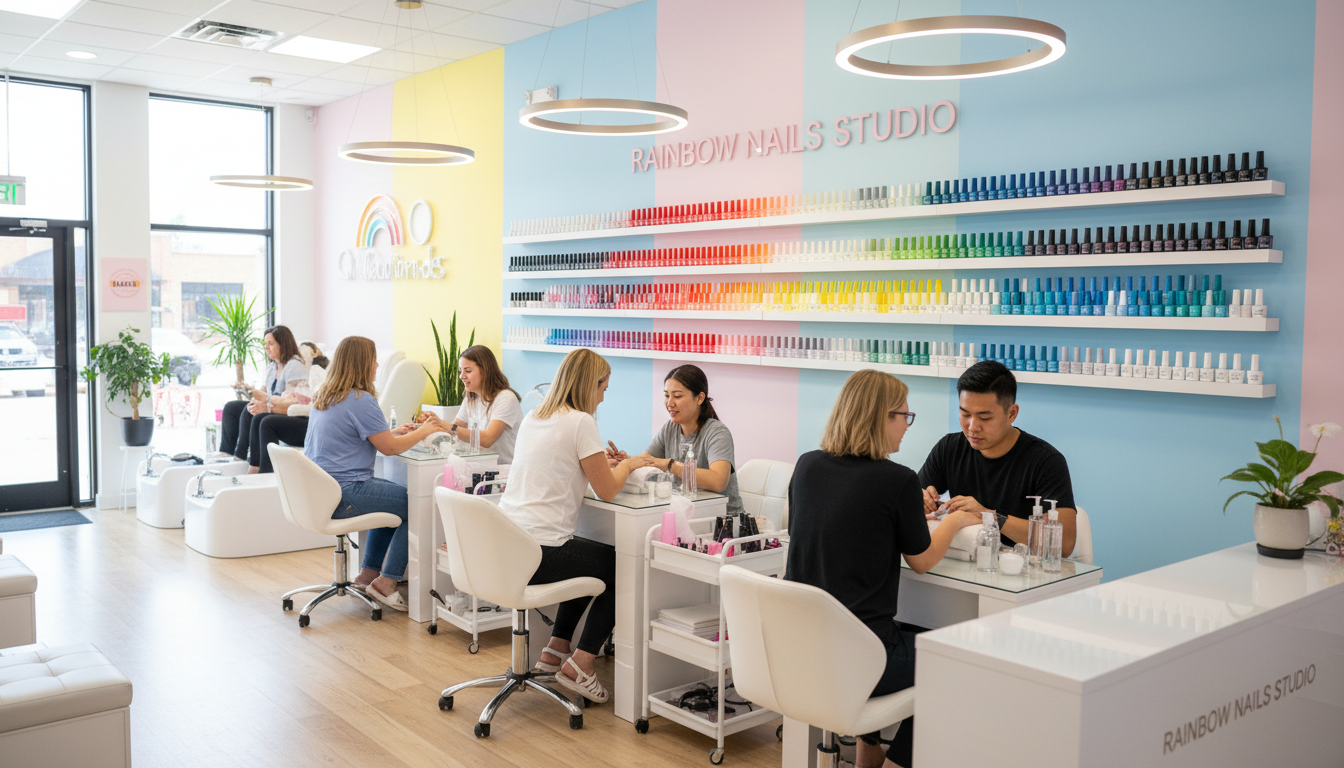
The rules are simple. Keeping them straight on a busy Saturday is not — and that's where the arguments start. Below you'll find the rules, a real morning played out step by step, a turn sheet you can copy, and what changes when a turn tracker does the bookkeeping for you.
The basics: who's "up"
Every walk-in nail salon runs some version of the same system:
- Techs join the rotation as they clock in. First in the door is first up.
- The tech at the top takes the next walk-in. That tech is "up."
- After a full service, they go to the bottom. Everyone else moves up one spot.
- Half turns don't send you to the back. A quick service counts as half. Two halves equal one full turn, and then you drop to the bottom.
That fourth rule is the one shops get wrong most often. If a tech does a $12 polish change and loses her place to someone about to get a $65 full set, she'll notice — and she'll be right to be upset.
These are exactly the rules SupaDay's turn tracker runs on, so everything below works the same on paper and in the app.
Full turns vs. half turns
A full turn is a regular service: a manicure, a pedicure, a fill, a full set.
A half turn is a small job that shouldn't cost a tech her place. Most salons define it one of two ways:
| Method | How it works | Good for |
|---|---|---|
| Service list | Specific services count as half: polish change, nail repair, eyebrow wax | Simple to explain, easy to remember |
| Price cutoff | Any service under a set price counts as half (e.g., under $25) | Stays fair as your menu changes |
Pick one. Mixing them — "polish changes are half, except when..." — is how arguments start. And if your shop doesn't use half turns at all, that's fine too; SupaDay's turn tracker lets you switch the half button off.
Watch a real morning play out
Rules are easier to follow when you see the order move. Here's a Saturday morning with four techs. The name in bold is who's up next.
| Time | What happens | Up next after |
|---|---|---|
| 9:30–9:55 | Linda, Tina, and Kim clock in | Linda → Tina → Kim |
| 10:05 | Full set walks in. Linda takes it: one turn | Tina → Kim → Linda |
| 10:20 | Pedicure. Tina takes it: one turn | Kim → Linda → Tina |
| 10:40 | Polish change. Kim takes it: half turn | Kim (½) → Linda → Tina |
| 10:55 | Eyebrow wax. Kim again: half turn — now a full turn | Linda → Tina → Kim |
| 11:00 | Vy clocks in | Linda → Tina → Kim → Vy |
| 11:10 | Linda steps out for lunch | Tina → Kim → Vy · Linda on break |
| 11:20 | Manicure. Tina takes it: one turn | Kim → Vy → Tina · Linda on break |
| 11:40 | Linda is back | Linda → Kim → Vy → Tina |
Three things worth noticing:
- Kim did two quick jobs and stayed on top the whole time. Half turns didn't cost her a place until they added up to one.
- Vy clocked in last, so she started at the bottom. Nobody had to decide that — arrival order did.
- Linda's lunch cost her nothing. She kept her spot while she was out and came back at the top.
In SupaDay, every one of those reorders happens automatically the moment the front desk taps Half or Full. Nobody erases and rewrites anything.
Write down the rules that cause fights
Almost every turn argument comes from a situation the shop never decided on. Settle these in writing before they come up:
Do request clients count as a turn? A regular walks in asking for Linda. Does Linda lose her place in the walk-in line?
- Count it: busy techs with lots of regulars don't also collect every walk-in. More even.
- Don't count it: techs are rewarded for building a clientele. Better for retention.
Neither is wrong. Switching between them depending on the day is wrong. (When clients check in through SupaDay's QR code, they can pick a preferred tech, so the front desk sees the request before assigning anyone.)
How long can a tech step out? Most shops let techs keep their place if they're back within a set time — 15 minutes, 30 minutes. Pick the number and say it out loud.
What if a tech turns down a client? The common rule: passing on a turn sends you to the bottom as if you took it. Otherwise techs start cherry-picking.
Do appointments count? Most shops don't count booked clients as turns, but the tech is "busy" until she's done. SupaDay shows each tech's next appointment right next to her name, so the front desk doesn't hand a walk-in to someone with a 2:30 booking.
What about techs who arrive late? Arrival order means the late tech is last up. That's the fairness built into the system — say so plainly.
Who can change the order? Name one person — owner or manager — who can fix the list. In SupaDay only managers and admins can log turns or reorder the list, so nobody can quietly move themselves up.
A turn sheet you can copy
This sheet uses the same layout as SupaDay's turn tracker, so if you start on paper, switching later feels familiar. It has two parts.
Part 1 — Up next. Keep this on a whiteboard. Every time someone takes a turn, rewrite the order. Here's the board at 11:20 from the morning above:
| Up | Tech | Note |
|---|---|---|
| NEXT | Kim | |
| 2 | Vy | Appointment at 2:30 |
| 3 | Tina | |
| On break | Linda | Out at 11:10 — keeps her spot |
Part 2 — Turns today. Keep this on paper so it doesn't get erased. Draw one box per client, left to right. Write one turn in the box for a regular service. For a small service, write half turn — and when that tech does her next half turn, finish the same box instead of starting a new one.
| Tech | In | Turns (oldest → newest) | Total |
|---|---|---|---|
| Linda | 9:30 | ● one turn | 1 |
| Tina | 9:40 | ● one turn · ● one turn | 2 |
| Kim | 9:55 | ● one turn (half turn + half turn) | 1 |
| Vy | 11:00 | 0 |
Requests (not counted as turns): none yet today.
● = one turn · ◐ = half turn waiting for its other half
At 10:40, Kim's row showed ◐ half turn. At 10:55, her second half turn filled the same box, and it became ● one turn. That's exactly how SupaDay's turn history draws it: a half-shaded box that fills in when the second half arrives.
Where paper falls apart — and what fixes it
The sheet works for three techs on a slow Tuesday. On a Saturday, it breaks in predictable places:
| On paper | With SupaDay's turn tracker |
|---|---|
| Someone finishes and nobody updates the board | Tap Half or Full and the order re-sorts itself instantly |
| A half turn gets forgotten, and the math goes quietly wrong | Half turns stack automatically, with "0.5 pending" shown next to the tech until they add up |
| The tech doing a pedicure in the back can't see the board | The live list sits on the front desk tablet where the whole shop can see it |
| Yesterday's board was wiped, so there's nothing to check | Every turn is saved by date — pull up any day in seconds |
| The owner steps out and the rules slip | The owner watches the live list from her phone, wherever she is |
| Someone "fixes" the order in their own favor | Only managers and admins can log turns or reorder the list |
| A wrong tap or a wrong mark | Tap Undo, and the order rebuilds itself correctly |
What a turn tracker does for your shop
The real product isn't the list. It's what happens to your shop when nobody has to argue about the list.
Techs stop fighting, because the order isn't anyone's opinion. When the list moves by the same rules every time, "you skipped me" stops being a debate. It's either on the screen or it isn't.
You can leave the floor. The rotation doesn't depend on you standing at the front desk. The staff at the desk runs it, and you can check in on the live list from your phone during an errand, a school pickup, or a day off.
Walk-ins get seated faster. Clients scan a QR code at the door with their phone, pick a preferred tech if they have one, and join the check-in queue. The front desk sees how long each person has been waiting and serves them with one tap.
Disputes take ten seconds. When a tech says she's been shorted all week, open the history, pick the day, and look. No memory contests.
There's nothing to learn. Clock techs in as they arrive. Tap Half or Full. Tap On Break and Back In. At closing, Clock Out All clears the rotation for tomorrow and keeps today's history.
Good techs stay. Techs who feel shorted on turns are the ones who leave for the salon down the street. A fair, visible rotation is one of the cheapest ways to keep them.
Getting set up
- Turn on the turn tracker and decide whether your shop uses half turns.
- Put a tablet at the front desk, then download the check-in QR code and print it for your front desk.
- Clock techs in as they arrive and start tapping Half or Full.
The turn tracker is included on SupaDay's Grow plan at $14 per tech per month, capped at $99/month, with walk-in check-in, commission tracking, and SMS reminders in the same plan. For more on the check-in side, see how a nail salon check-in system cuts wait times. Try it free for 30 days →
One thing to know about turn rotations
If your shop assigns walk-ins through a turn rotation, the techs in that rotation are working your clients at your direction. That's normal for a walk-in salon — but it matters if you pay those techs as booth renters or 1099 contractors. See is a booth renter an employee or contractor? before you set up pay that way.
The bottom line
A fair turn system is arrival order, full turns to the bottom, and half turns that don't cost anyone their place. Keeping the peace comes from deciding the hard cases — requests, breaks, refusals — once, in writing.
Paper gets you started. When the shop gets busy enough that marks go missing and the owner can't be at the front desk all day, a live turn tracker the whole team can see is what ends the arguments. See how SupaDay works for nail salons →