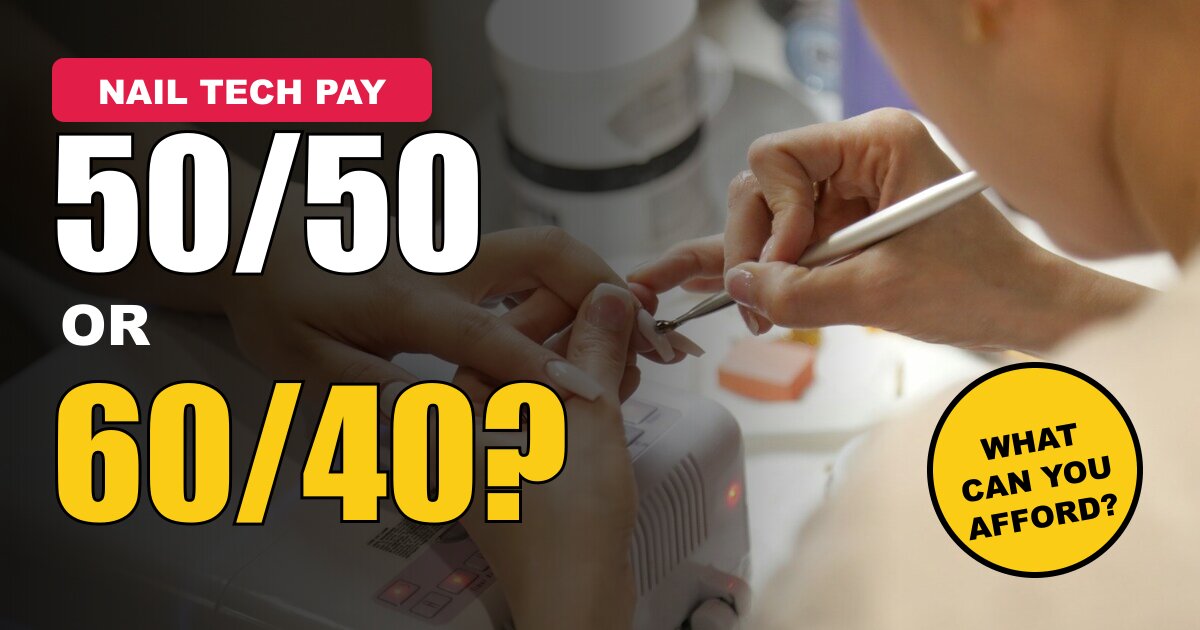
Ask ten nail salon owners what they pay and you'll hear "50/50," "60/40," "55 with a guarantee," and a few things in between. There's no single right number. There is a right way to choose one, though, and it starts with your salon's costs, not with what the shop down the street pays.
This article explains common pay setups. It is not legal or tax advice. Minimum wage, deduction and overtime rules vary by state. Talk to a CPA or employment attorney before you change how you pay anyone.
The common nail tech commission splits
These are the splits owners report most often. They come from industry surveys and salon software guides, not one official study, so treat them as a starting range.
| Tech's share | Who it usually fits |
|---|---|
| 40%–45% | New techs, apprentices, techs still building speed |
| 50% (50/50) | The most common starting point for an experienced tech |
| 55% | Strong techs, or a 50% base with a raise after a few months |
| 60% (60/40) | Senior techs, busy salons, techs who bring regular clients |
| 65%+ | Techs who buy their own product; close to booth rent territory |
Tips are separate. In almost every salon, the tech keeps all of their tips, on top of the split. Tips usually add 15% to 25% of the service price.
For comparison, the Bureau of Labor Statistics puts the median pay for manicurists and pedicurists at $17.19 an hour (May 2025). That figure includes commission but not every cash tip, so real take-home pay at a busy salon is often higher.
How to work out the split your salon can afford
Start with what the salon has to keep from every $100 of services. Then whatever's left is the most you can pay in commission.
A typical breakdown for a nail salon:
- Supplies: polish, gel, acrylic, liners, files, towels. Often 8% to 12% of service revenue.
- Card fees: about 3% on card payments.
- Overhead: rent, utilities, insurance, front desk, laundry, software. Often 25% to 30%.
- Profit: what you need to earn for running the shop. Aim for at least 10%.
A worked example
Say your numbers are 10% supplies, 3% card fees, 27% overhead and a 10% profit target. That adds up to 50%.
- Salon keeps: 50%
- Most you can pay in commission: 100% − 50% = 50%
At a 60/40 split, the same salon would lose money on every service unless it raised prices or cut overhead. That's why two salons in the same town can pay very different splits and both be fair.
Run it per service, too. Acrylic full sets and gel-X use more product than a basic manicure. Some salons pay a lower rate on product-heavy services or a higher rate on simple ones, so each service still covers its costs.
Commission, guarantees and minimum wage
Straight commission is legal for employees, but only if it covers minimum wage for every hour worked. A tech who waits three hours for walk-ins on a slow Tuesday is still working those hours.
When commission falls short, the salon owes the difference. We walk through the weekly check in does commission count toward minimum wage.
Many salons handle this with a daily guarantee: the tech earns their commission or a set amount for the day, whichever is higher. A guarantee keeps good techs from leaving after a slow week. It also covers the minimum wage gap, but only if the daily amount is at least the minimum wage times the hours the tech actually works that day. Overtime still applies past 40 hours a week.
Tiered commission: paying more for more work
A tiered split raises the rate once a tech passes a weekly sales target. For example:
- 50% on the first $1,500 in services each week
- 55% on everything above $1,500
Tiers reward your busiest techs without raising costs on slow weeks. Keep the targets simple enough that a tech can check their own pay. Confusing tiers cause more arguments than they solve.
What can come out of a tech's commission
Owners sometimes deduct a supply fee or the card fee on tips. Be careful with both.
- Deductions can't drop an employee below minimum wage for the week.
- Card fees on tips: federal rules allow a salon to take out the actual processing fee on a card tip, but some states, including California, don't. There, the tech gets the full tip.
- Put it in writing. Any deduction belongs in the pay agreement the tech signed, not something they find out about on payday.
Paying part in cash doesn't change the rules
Some salons pay part of a tech's pay by check and part in cash. Cash pay is still wages. It counts for taxes, minimum wage and overtime the same as a check. Paying it off the books puts the salon at risk in an audit.
Whether a tech is an employee or a 1099 contractor also changes what you owe. Commission techs who work your schedule and your prices are usually employees. See can I pay my nail techs 1099 for how that's decided.
Track every tech's commission at checkout
The split is only fair if the numbers are right. Paper tickets and end-of-week calculators lead to mistakes, and mistakes lead to arguments.
With SupaDay, every ticket records which tech did each service. Commission tracking applies each tech's own rate, lets you set a different rate for specific services, and keeps card tips and cash tips in separate columns. At the end of the week you see each tech's total, ready to check. It works alongside the turn tracker most nail salons already use for walk-ins.
The bottom line
A 50% to 60% split with tips kept by the tech is normal for nail salons, but the right number is whatever your costs allow. Work out what the salon has to keep, set the split from there, and cover slow days with a guarantee. Then let SupaDay do the weekly math so payday is quick and nobody argues over the numbers.