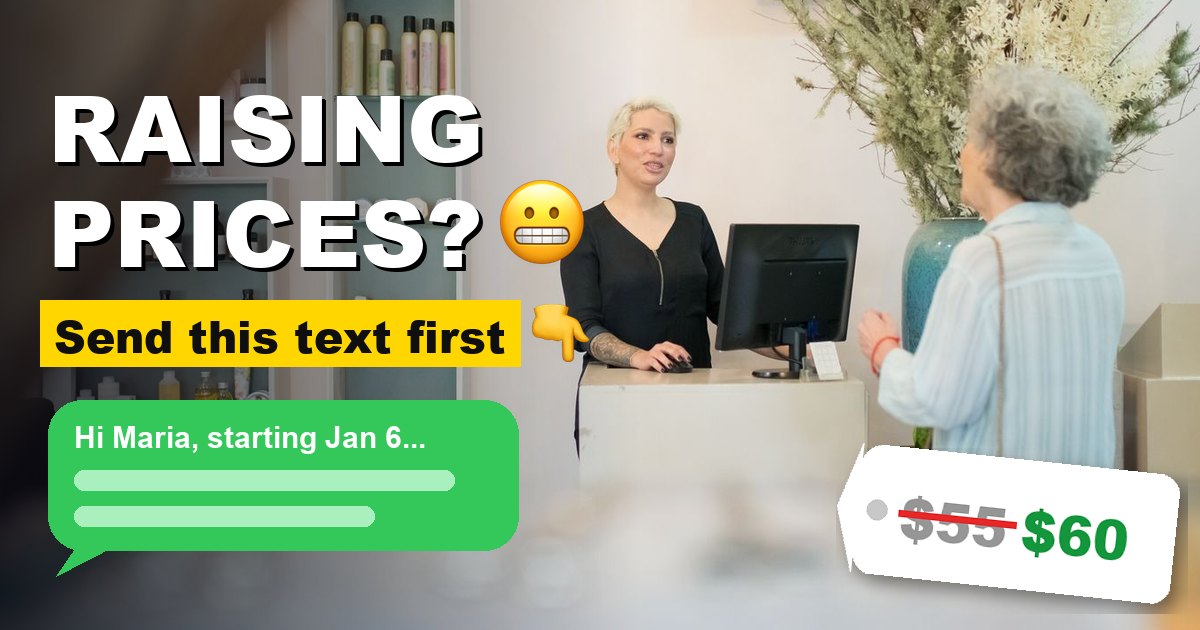
Most salon owners wait too long to raise prices. Rent goes up, product goes up, you get better at what you do, and the price list stays the same because you're scared the regulars will leave.
Most of them won't, if you do it well. The clients who leave over a fair, well-announced raise are often the ones who were already shopping around. Here's how to do it with the least drama.
Is it time to raise your prices?
You're probably overdue if any of these sound familiar:
- You're booked out for weeks. Demand is higher than your supply, and your price is the easiest lever.
- Your costs went up. Color, wax, gel, rent, card fees. If your prices didn't move, your take-home went down.
- It's been more than a year. Prices that never change quietly get cheaper every year.
- You got better. A new certification, a new technique, more years in the chair.
- Your best stylists or techs are asking for more. Their pay usually comes out of the same ticket. (See how commission splits for hair stylists and nail techs work.)
One or two of these is enough reason. Three or more and you're leaving money on the table every week.
How much should you raise them?
A small raise every year is easier on clients than a big jump every three years. For many salons that lands somewhere around 5 to 10%, but treat that as a starting point, not a rule. Your own numbers matter more.
Go through your menu one service at a time and ask three questions:
- How long does it really take? Count the whole appointment, including consultation, cleanup and processing time.
- What does the product cost you now? Not what it cost two years ago.
- How in demand is it? If people book it weeks out, it can take a bigger raise.
Then sort your services into three groups:
- Raise the most: services you're booked out on, and services that barely cover your time and product.
- Raise a little: your steady everyday services.
- Leave alone for now: entry-level services that bring new clients in, like a basic cut, a lineup or a brow wax.
Round to clean numbers. $65 reads better than $63.50.
Example: one hair salon's new price list
This is a made-up example to show the thinking, not industry data.
| Service | Old price | New price | Why |
|---|---|---|---|
| Women's cut | $55 | $60 | Steady demand, small raise |
| Single-process color | $95 | $105 | Color costs went up |
| Balayage | $180 | $200 | Booked out three weeks ahead |
| Blowout | $40 | $40 | Entry service, left alone |
| Men's cut | $30 | $32 | Small raise, keeps it simple |
The same thinking works anywhere. A barbershop might move a fade from $30 to $35 and leave the lineup at $15. A nail salon might raise gel-X and full sets and leave a basic manicure where it is. A lash studio might raise full sets more than fills, since fills keep regulars coming back on schedule.
The countdown calendar
Timing does half the work. Here's a simple schedule, counting back from the day the new prices start:
| When | What to do |
|---|---|
| 8 weeks before | Finish your new price list. Pick a start date outside your busiest week. |
| 6 weeks before | Tell your staff: the date, the new prices, the reason, and what to say. |
| 4 to 6 weeks before | Announce it to clients: a text or email, a sign at the front desk, a post on Instagram. Mention it in person at every visit. |
| 2 weeks before | Send a short reminder. |
| Start date | Update your price list everywhere: booking page, website, menu at the desk. |
| 4 and 12 weeks after | Check your numbers (more on that below). |
Why four to six weeks? Most regulars come in every four to eight weeks, so give at least a month's notice. That way nearly everyone hears it face to face, from someone they trust, before it shows up on a receipt.
Good times to start: January, after the holidays, when many businesses change prices. Or right after a slow stretch, so you're not changing the menu in the middle of prom or wedding season.
Tell your staff first
Clients will ask your team before they ask you. Make sure everyone gives the same answer. Before you announce anything, sit down with your staff and cover:
- The start date and the new prices, printed out.
- One sentence on why. For example: "Our product and rent costs went up, and we haven't changed prices in over a year."
- What to say when a client pushes back (scripts below).
- What it means for their pay. If they're on a commission split, a higher ticket usually means a bigger paycheck. Say so. It turns your team into supporters instead of nervous messengers.
The texts and messages to copy
Keep every message short and calm. Say what's changing and when, give one line of why if you like, and stop. Don't apologize, and don't write a paragraph defending yourself.
Announcement text (4 to 6 weeks before):
Hi Maria, a quick heads-up from Studio Bloom: starting January 6, some of our prices are changing. You can see the new price list here: [link]. Anything you've already booked before then stays at today's price. Thank you for being with us!
Reminder text (2 weeks before):
Hi Maria, just a reminder that our new prices start January 6. Want to lock in your next visit before then? Book here: [link]
What to say in person at checkout:
"Before you go, I wanted to let you know personally: our prices are going up a little on January 6. Your color will be $105. Anything you book before then stays at today's price."
When a client says "Why so much?":
"I get it. Our product and rent costs have gone up, and we want to keep using the same quality color on you. If you'd like to keep it closer to what you're used to, we could do a gloss between full color visits."
Sign for the front desk:
New prices start January 6. Ask us about the new menu. Anything booked before then stays at today's price.
Bookings already on the calendar
Decide this up front and say it clearly in every message: appointments booked before the start date keep the old price. It's fair, it's easy to explain, and it gives regulars a nice reason to book their next visit early.
What's harder to manage is keeping certain clients on the old price for good. Two price lists, staff guessing who gets which, regulars comparing notes. If you want to thank your most loyal clients, give them a personal heads-up a few weeks before everyone else instead.
When a client pushes back
A few clients will push back. That's normal, and most of them will still rebook. A few rules:
- Don't apologize. "I'm so sorry, I know it's a lot" tells the client the price is wrong.
- Don't discount on the spot. If one client talks you down, the whole price change starts to unravel.
- Offer a different service, not a lower price. A shorter service, a simpler style, or more time between visits keeps the client and keeps your prices whole.
- Let a few go. A client who leaves over a fair raise opens a spot for one who values your work. A few lost clients at a higher price can still mean more money for fewer hours.
After the raise: check your numbers
Four weeks after the start date, and again at twelve weeks, look at:
- Rebooking: are your regulars still booking their next visit at about the same rate?
- Average ticket: it should be up. If it isn't, check whether clients switched to cheaper services.
- Who stopped coming: look at regulars who haven't been back. Some are just late. A friendly "we miss you" text often brings them back.
- Total sales: compare with the same weeks last year if you can, since salon business swings with the seasons.
If you lost more clients than you expected on one service, adjust that one service. Don't roll the whole raise back. For more ways to keep regulars coming back, see our guide to client retention for salons.
How SupaDay helps with a price change
SupaDay won't pick your prices for you, but it makes the rollout easier:
- One place to update prices. Change a service's price once in your account on the start date, and your online booking page shows the new price to anyone booking from then on.
- Message every client at once. With marketing campaigns on the Business plan, send your announcement and reminder as a text or email to all your clients, now or at a set time.
- Reminders that keep people showing up. Clients get an email when they book and an automatic text the day before, so new prices don't come with new no-shows. See appointment reminders.
- See how the raise went. Revenue reports show sales, average ticket and tips for any period and for each team member, so you can compare before and after.
Grow is $14 per team member a month, never more than $99. Business, which adds campaigns, is $22 per team member a month with a 3-person minimum, never more than $149. SupaDay takes no cut of your bookings. See all pricing.
The bottom line
Raising prices isn't the scary part. Doing it badly is: no warning, a vague reason, staff caught off guard, a client finding out at the register. Work out the new price service by service, give four to six weeks' notice, tell your staff first, send one short, calm message, and keep what's already booked at the old price. Then check your numbers a month later. Most of your regulars will still be in your chair. Start a 30-day free trial →