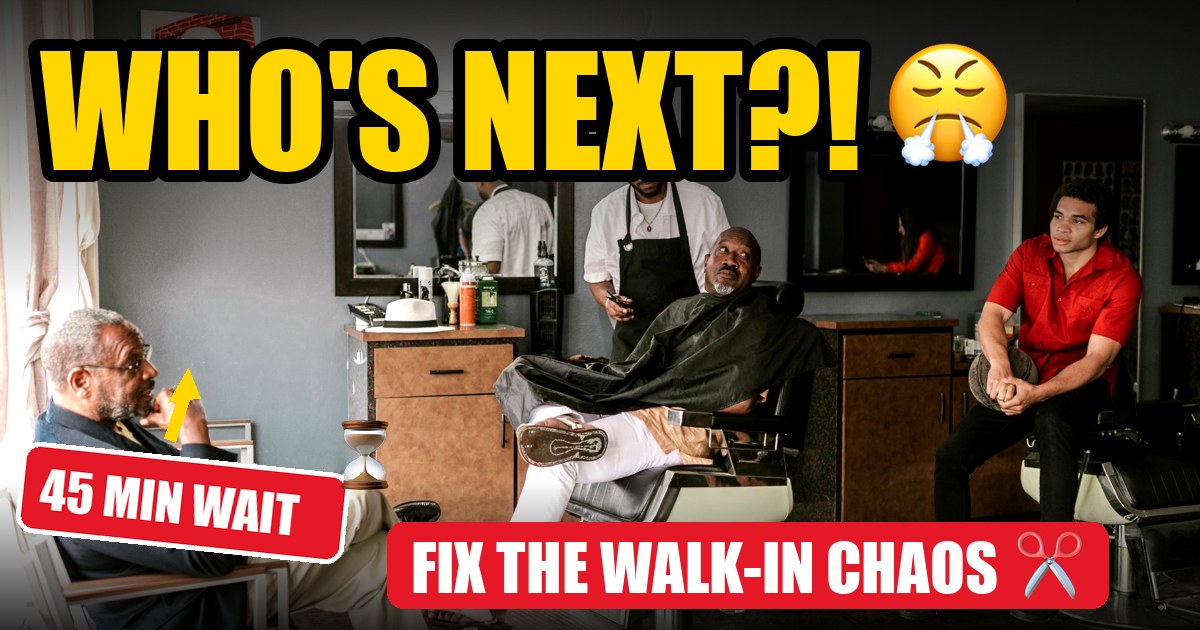
Most guides stop at the licence. The licence is the easy part. The hard part is the first month after it: empty chairs, a line at the door on Saturday, and a barber asking why his pay looks short.
This checklist covers both. The paperwork in the right order, then how to fill the chairs.
The 8-step checklist
| Step | What to do | How long |
|---|---|---|
| 1 | Pick your model (commission, booth rent or both) and set a budget | 1–2 weeks |
| 2 | Form the business: LLC, EIN, business bank account | 1–2 weeks |
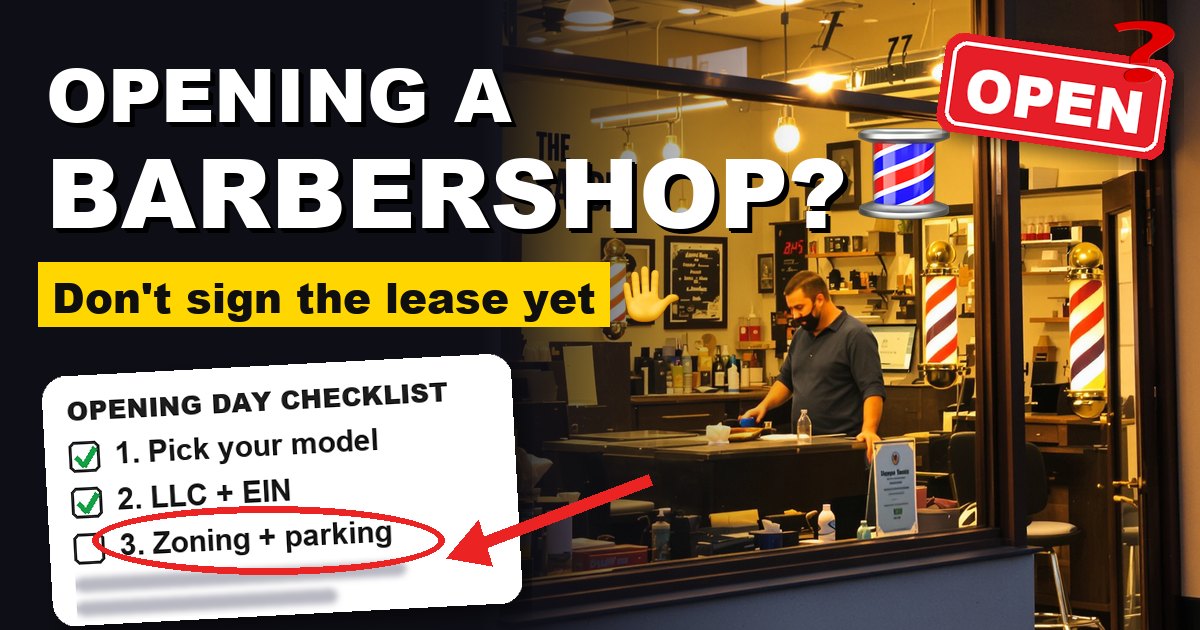
| 3 | Find a space; check zoning, certificate of occupancy and parking before signing | 2–6 weeks |
| 4 | Build out the space; order chairs and equipment | 4–8 weeks |
| 5 | Apply for the shop licence and book the inspection | 2–3 weeks |
| 6 | Insurance, local business licence, sales tax permit | 1–2 weeks |
| 7 | Hire barbers and put pay in writing | 2–4 weeks (during build-out) |
| 8 | Open your books: booking page, check-in, price list, Google profile | 1 week |
Some steps overlap. Hiring happens while the build-out is going on, and the licence paperwork goes in near the end of it. Plan on three to four months from "I'm doing this" to the first cut.
Before the lease: three checks that save you money
The most expensive mistake is signing a lease on a space where you can't legally run a barbershop. Do these three checks first, and ask the landlord for a few weeks to do them before you sign.
1. Zoning. Call your city's planning or zoning office with the address and ask: "Can a barbershop operate here?" Most retail zones allow it, but not all, and some cities treat a barbershop as "personal services" with its own rules.
2. Certificate of occupancy. Every commercial space has an approved use on file. If the last tenant was a clothing store, the space may not be approved for a barbershop. The City of Los Angeles barber shop starter kit puts it plainly: check the building's certificate of occupancy, and if the use doesn't match, you may need a change of use permit from Building and Safety.
3. Parking. Ask the city whether a change of use triggers a parking requirement. Then go look for yourself on a Friday evening and a Saturday morning. If clients can't park, they won't wait.
Licence and paperwork
Every state does this a little differently, so check your state's board of barbering (sometimes combined with cosmetology) for the exact list. Here is what almost every shop needs:
- Your barber licence. You or the barbers you hire need a state licence to cut hair.
- A shop licence. Most states license the shop itself, separate from the people in it, and inspect it before you open. In Texas, for example, the shop licence is $78 and a Class A barber licence is $50 (Texas Department of Licensing and Regulation fee table, fees in effect since September 1, 2023, checked November 3, 2026).
- A business entity. Most small shops form an LLC with their Secretary of State. It keeps the shop's debts separate from your own. Fees vary by state.
- An EIN. You need one to hire, run payroll and open a business bank account. It's free from the IRS and comes through online in minutes. Never pay a website for one (IRS.gov, page reviewed October 16, 2026).
- A local business licence from your city or county.
- A sales tax permit if you'll sell products like pomade or beard oil.
- Insurance. At minimum general liability. Add workers' comp once you have employees.
What it costs to open a barbershop
These are the published ranges we trust, each with its source and date:
| Cost | Range | Source |
|---|---|---|
| Total to open a standard barbershop | $50,000–$150,000 | Biz2Credit, small-business lender, February 2026 |
| Build-out (plumbing, flooring, lighting, wiring) | $10,000–$50,000 | Biz2Credit, February 2026 |
| Chairs, stations and equipment | $10,000–$25,000 | Biz2Credit, February 2026 |
| Licences and permits | $500–$2,000 | Biz2Credit, February 2026 |
| General liability insurance | about $37 a month ($440 a year) | Insureon, median for barbers, updated April 11, 2025 |
| Business owner's policy | about $68 a month | Insureon, April 2025 |
| Workers' comp | about $70 a month | Insureon, April 2025 |
Two lines that never make the list:
- The first months of rent before you're busy. A new shop rarely covers its rent in month one. Keep at least two to three months of rent and payroll in the bank on opening day.
- Software and card fees. Booking, check-in, checkout and barber pay all need a system. SupaDay is $14 per staff member a month on Grow, never more than $99, so a four-chair shop pays $56. There's a 30-day free trial with no credit card, and SupaDay takes no cut of your bookings. Standard card processing fees apply when clients pay by card. See pricing.
Chairs: commission, booth rent, or both
This is the decision that shapes everything else, and it's the one most new owners rush.
Commission (employees). Barbers work your schedule, charge your prices and get a share of what they cut, usually as W2 employees. You control the client experience, and you carry payroll, taxes and workers' comp. For a sense of pay, the median barber made $18.73 an hour in May 2024 (US Bureau of Labor Statistics, Occupational Outlook Handbook).
Booth rent (independent contractors). Barbers pay you a set weekly rent, keep what they earn, set their own hours and prices and usually keep their own clients. Rent runs about $125 to $450 a week in most of the US (SupaDay booth rent guide, September 2026). Here's how to set your booth rent from your real costs.
Both. Plenty of shops have two commission barbers and two renters. It works, but only if the rules are clear for each group.
Two things to get right whichever way you go:
- Classification follows how the shop really runs. If you set a renter's hours and prices, the law may see an employee, whatever the contract says. Read is a booth renter an employee or contractor and talk to a CPA before you sign anyone.
- Put pay in writing. The split, how tips are handled, what product costs come off the top, when payday is. Then track it from completed tickets, not a notebook. Here's how to track barber commissions without spreadsheets.
In SupaDay, each commission barber gets their own rate, with per-service overrides if a lineup pays differently from a full cut. Commission tracking works it out from completed tickets, keeps tips separate, and exports a CSV for payroll. Each barber can see his own earnings, which ends most payday arguments before they start.
The first week of bookings
Open with both walk-ins and appointments. Walk-ins fill the chairs while your book is empty. Appointments are what keep them full later.
- One visible line. Put a QR code by the door so walk-ins check themselves in, and show the line where every barber can see it. More on that in barbershop check-in and the walk-in queue.
- A written turn rule. Next walk-in goes to the next free barber. A client who asks for a specific barber waits for him. A lineup counts as a half turn. Post it.
- Honest wait times. People ahead × average cut time ÷ barbers working. Six ahead, 30-minute cuts, three barbers: about an hour. Round up.
- Reminders for booked clients. A text the day before and an hour before cuts no-shows more than anything else you can do in week one.
The full playbook is in how to run a walk-in barbershop.
The first 90 days: filling chairs
Week 1: Google Business Profile. Set it up before opening day with photos, hours, services and your booking link. It's how most people nearby will find you.
Weeks 1–4: bring the barbers' books. The fastest clients are the ones your barbers already have. Give each barber his own booking link to send to his regulars on day one.
Every visit: rebook at checkout. "Same time in three weeks?" is the cheapest marketing a barbershop has. A client who leaves with the next cut booked comes back.
Every visit: ask for a review. The first 20 to 30 Google reviews move you up in local search. Ask every happy client, in person or by text.
Weeks 4–12: fill the quiet hours. Look at check-ins by hour. When Tuesday 2–5 pm is empty, text your regulars that there's no wait on Tuesday afternoons. No discount needed. Convenience is the offer.
Every week: check your numbers. Cuts per barber, rebooking and no-shows. Fix small problems early.
How SupaDay runs a new shop from day one
SupaDay is built for shops that mix walk-ins and appointments:
- Online booking for Instagram, Google, your website and a QR code, showing only open times.
- QR check-in and a walk-in queue that feeds a shared turn tracker with half turns.
- Text and email reminders, the day before and an hour before. 500 texts a month on Grow, 2,000 on Business.
- Commission tracking, staff schedules, and checkout for card (tap with a card reader), cash and gift cards, with sales reports by barber.
Grow is $14 per staff member a month, never more than $99, for up to 10 staff. Business is $22 per staff member a month with a 3-person minimum, never more than $149, and adds automatic Google review requests after each visit. Comparing options? See the best barbershop software.
The bottom line
Opening a barbershop is a checklist, not a mystery. Check zoning and the certificate of occupancy before you sign anything, get the paperwork done in order, decide how your barbers get paid and put it in writing, and open your books a week early. Then spend the first 90 days on the boring stuff: a visible line, reminders, rebooking at checkout and reviews. That's what fills chairs. See how SupaDay works for barbershops →