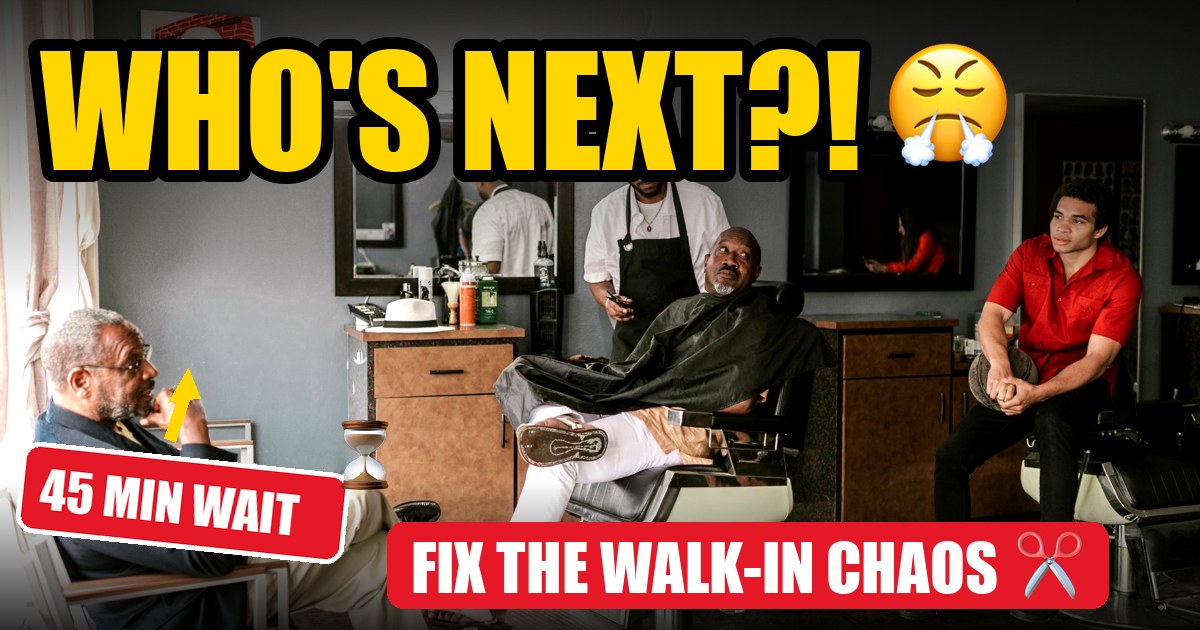
Walk-ins are the heartbeat of a lot of barbershops. They're also where the chaos starts: a crowd by the door, nobody sure who's next, two barbers reaching for the same client, and a guy who's been waiting 40 minutes walking out.
None of that is about cutting hair. It's about running the line. Here's how to do it.
Why walk-ins get chaotic
Most walk-in problems come from the same few gaps:
- No visible line. Clients don't know where they stand, so they hover, ask, or leave.
- No clear turn rule. Barbers argue over who's up, and someone always feels shorted.
- No honest wait time. "Shouldn't be long" turns into an hour, and the client doesn't come back.
- Appointments colliding with walk-ins. A barber picks up a walk-in five minutes before his booked client arrives.
- Everyone shows up at once. Saturday at 11 am, with the same staff as Tuesday at 2 pm.
Fix those five, and most of the chaos goes away.
1. Make the line visible
The first fix is a single line everyone can see.
- Check clients in when they arrive. A clipboard works on a slow day. A QR code by the door or a tablet on the counter works better, because clients add themselves and you don't lose names.
- Show the line. Put it on a screen or tablet your barbers can see from the chair. When a barber finishes, he knows exactly who's next without asking.
- Record what they want. A cut, a lineup, a beard trim. It helps you judge the wait and pick the right barber.
When the line is visible, clients stop asking "how many ahead of me?" and barbers stop guessing. (More on setting this up in our guide to barbershop check-in systems and walk-in queues.)
2. Write down your turn rule
"Whose turn is it?" causes more arguments in a barbershop than anything else. Settle it once, in writing:
- Next available: the next walk-in goes to the next barber in the rotation who's free.
- Requests: a client who asks for a specific barber waits for that barber, and it counts as that barber's turn.
- Quick services: decide how a lineup or beard trim counts. Many shops treat it as a half turn, so a barber doing quick work doesn't fall behind or jump ahead.
- Breaks: a barber who steps out for lunch keeps his place, or goes to the back of the rotation. Pick one.
- Regulars at the door: a regular who walks in without booking still joins the line. Fair is fair.
Post the rule where every barber can see it, and keep the turn count visible all day. When everyone can see how many cuts each barber has done, the arguments mostly stop. A shared turn tracker does the counting for you.
3. Give honest wait times
Clients will wait. What they won't forgive is a wait that's twice as long as you said.
A simple way to estimate:
Wait ≈ (people ahead × average cut time) ÷ barbers working
Six people ahead, 30-minute cuts, three barbers: about an hour. Round up, never down.
A few habits that help:
- Tell them at check-in, not after 20 minutes.
- Let them step out. A client who can grab food and come back is happier than one stuck in a chair. Take a phone number so you can call or text when they're close.
- Be straight when it's too long. "It's about 90 minutes today. Want to book a time tomorrow instead?" keeps the client even if you lose the cut.
4. Mix walk-ins and appointments without collisions
Most shops end up with both. Three ways to keep them from clashing:
| Approach | How it works | Best for |
|---|---|---|
| Appointment barber | One barber takes appointments only, the rest take walk-ins | Shops with one or two barbers who have a full book |
| Set hours | Appointments in the morning, walk-ins in the afternoon (or the reverse) | Shops with predictable busy times |
| Skip rule | When assigning a walk-in, skip any barber with an appointment in the next 30 minutes | Shops where every barber takes both |
Whichever you choose, the walk-in line has to know who's booked. A barber with a 3 pm appointment shouldn't take a fade at 2:45.
5. Staff for the rush
Look at when you're actually busy. For most barbershops it's Saturday late morning through early afternoon, and weekdays after work.
- Count your check-ins by hour for a couple of weeks. The pattern usually jumps out.
- Put your full crew on during the peak and fewer barbers on the slow stretches.
- Stagger breaks so you never lose two chairs in the rush.
- Keep quick services quick. During the rush, a lineup shouldn't take a 45-minute slot.
6. Keep the chair turning
Small delays between clients add up across a busy day:
- Post your prices so nobody holds up the line asking.
- Make checkout fast. Tap to pay and a quick tip screen beat counting change.
- Have the next client ready. When a barber is finishing, the next person in line should already be up and waiting by the chair.
7. Turn walk-ins into regulars who book
Some of your best walk-ins would happily book if it were easy. Every one who books is one less person in Saturday's line.
- Offer a booking link at checkout: "Next time, grab a time here and skip the wait."
- Put the link in your Instagram bio and Google profile. (See how to add a booking link to Instagram.)
- Keep walk-ins welcome. The goal is a calmer line, not turning people away.
Saturday rush checklist
- ✅ Check-in point ready (QR code by the door, tablet on the counter)
- ✅ Line visible to every barber
- ✅ Turn rule posted, including requests, half turns and breaks
- ✅ Full crew scheduled for the peak, breaks staggered
- ✅ Appointments known to the walk-in line
- ✅ Wait-time estimate ready to tell clients at check-in
- ✅ Booking link ready for clients who'd rather come back
How SupaDay runs the walk-in line
SupaDay was built for shops that live on walk-ins:
- Self check-in: clients scan a QR code at the door or tap a tablet, and pick a barber or "next available".
- A shared line: walk-ins appear on the turn tracker the moment they check in, and your crew sees who's next.
- Fair turns: a live rotation with half turns, breaks that keep a barber's place, and a count of each barber's cuts for the day.
- Appointments in the same place: online booking for regulars, with text reminders, so walk-ins and booked clients share one calendar.
The Grow plan is $14 per barber a month, capped at $99, so a 4-chair shop pays $56. Comparing options? See the best barbershop software and apps for walk-ins and Booksy vs Squire vs theCut.
The bottom line
A busy walk-in shop doesn't need more chairs as much as it needs a better line. Make the line visible, write down the turn rule, tell clients the real wait, keep appointments from colliding with walk-ins, and staff for the rush. Do that, and Saturday stops feeling like chaos. See how SupaDay works for barbershops →